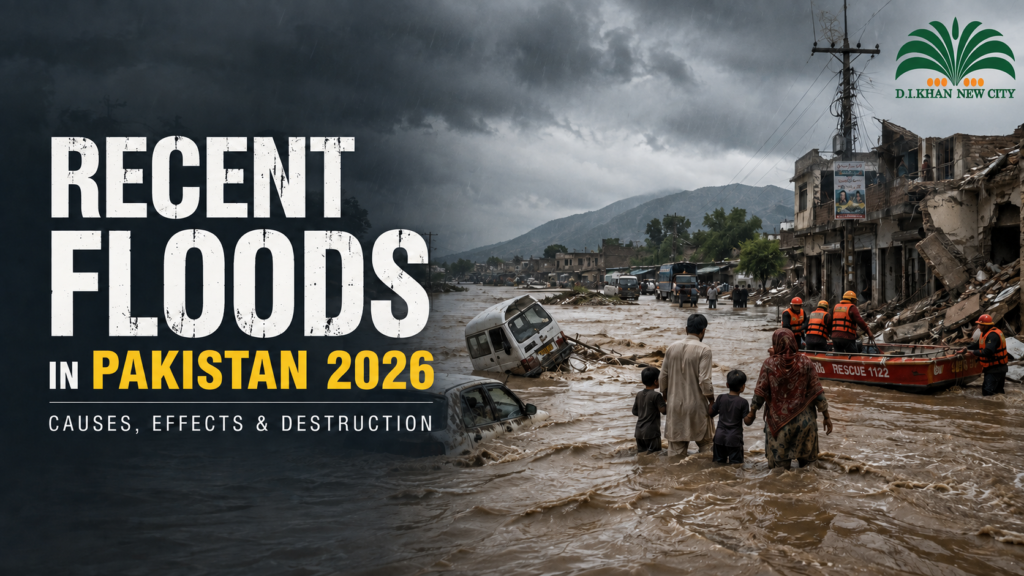
Pakistan is once again facing the destructive consequences of monsoon rains, flash floods, urban flooding and weather-related disasters in 2026.
From mountainous areas of Khyber Pakhtunkhwa and Gilgit-Baltistan to communities in Punjab, Sindh, Balochistan and Azad Jammu & Kashmir, this year’s monsoon season has affected lives, homes, livestock and infrastructure.
According to the National Disaster Management Authority (NDMA), from 26 June to 3 September 2026, monsoon-related incidents across Pakistan had caused 180 deaths and 509 injuries. The official data also recorded 1,716 damaged houses and 1,483 livestock losses during this period.
The floods are not simply the result of “too much rain.” Pakistan’s flood risk is shaped by a combination of intense weather, geography, climate change, rapid urban development, inadequate drainage and long-term environmental pressures.
Understanding these causes is becoming increasingly important because extreme weather is no longer an occasional national concern. It is becoming a recurring challenge to communities, infrastructure and economic stability.
Current Flood Situation in Pakistan in 2026
Pakistan’s 2026 monsoon season began bringing significant weather-related losses from late June.
NDMA figures up to 3 September 2026 show that Khyber Pakhtunkhwa had recorded the highest number of deaths, at 74, followed by Punjab with 61. Sindh recorded 17 deaths, Azad Jammu & Kashmir 16, Balochistan eight, Islamabad Capital Territory three and Gilgit-Baltistan one. Children accounted for 82 of the 180 recorded deaths, highlighting the particularly severe human cost of the monsoon season.
Damage has also extended beyond human casualties. NDMA recorded 589 completely destroyed homes and 1,127 partially damaged homes, taking the total to 1,716 houses.
Gilgit-Baltistan alone accounted for 535 damaged houses and 910 livestock losses, while Khyber Pakhtunkhwa recorded 380 damaged houses.
Infrastructure has also suffered. By 3 September, NDMA had recorded approximately 34.56 kilometres of damaged roads and 41 damaged bridges during the monsoon period. More than 10,650 people had been rescued or evacuated nationwide.
These numbers may continue to change as the monsoon season progresses and damage assessments are updated.
Why Are Floods Happening in Pakistan?
1. Intense Monsoon Rainfall
The most immediate cause of flooding is heavy monsoon rainfall.
Pakistan receives much of its seasonal rain between June and September. When large amounts of rain fall within a short period, rivers, streams, hill torrents and urban drainage systems may not have enough capacity to carry the water safely.
During the 2026 season, the Pakistan Meteorological Department repeatedly reported weather systems involving monsoon currents from the Arabian Sea and Bay of Bengal, together with low-pressure systems and westerly waves.
For example, late July forecasts warned of widespread rainfall and heavy to very heavy falls across several regions, with rising river levels and increased risks of flash and urban flooding.
This matters because total seasonal rainfall is only part of the story. A region may receive average or even below-average rainfall overall while still experiencing a short period of extremely intense rain capable of producing disastrous flash floods.
2. Erratic Weather and Climate Change
Climate change does not mean that every individual flood can automatically be blamed on global warming. Weather attribution requires proper scientific analysis.
However, scientists increasingly warn that a warmer climate can intensify several conditions associated with destructive flooding.
In July 2026, the International Centre for Integrated Mountain Development (ICIMOD) warned that rising temperatures and increasingly erratic monsoon patterns were heightening flash-flood risks across the Hindu Kush Himalayan region. Scientists highlighted a dangerous pattern of longer dry periods interrupted by sudden, intense rainfall.
Warmer air can hold more moisture, while changing atmospheric circulation can alter rainfall distribution. This can contribute to highly concentrated rainfall events rather than gentle and evenly distributed seasonal rain.
For Pakistan, therefore, climate adaptation is increasingly becoming a matter of infrastructure, planning and public safety rather than an abstract environmental debate.
3. Glacier Melt and Glacial Flood Risks
Northern Pakistan faces another challenge: its enormous glacier systems.
The Hindu Kush, Karakoram and Himalayan regions contain thousands of glaciers that contribute water to the Indus River system.
Higher temperatures can accelerate snow and ice melt and contribute to the formation or expansion of glacial lakes. When the natural barriers holding these lakes fail, they can produce Glacial Lake Outburst Floods, commonly known as GLOFs.
Research cited by ICIMOD has warned that increasing temperatures in northern Pakistan can increase snow and ice melt and contribute to potentially dangerous glacial lakes.
These events are particularly dangerous because floodwater can travel rapidly through narrow mountain valleys while carrying rocks, mud, trees and debris.
4. Pakistan’s Geography
Pakistan’s geography naturally makes parts of the country highly exposed to flooding.
The Indus River and its tributaries form one of the country’s most important water systems. Communities, agriculture and economic activity have historically developed around these rivers because water is essential for farming and settlement.
But the same river systems can become dangerous during extreme rainfall or unusually high flows.
Mountainous regions face flash floods and landslides. Plains can experience river flooding. Southern and coastal areas can face waterlogging and urban flooding.
In other words, Pakistan has managed to collect several different types of flood risk within one country. Geography apparently believed specialization was overrated.
5. Poor Drainage and Rapid Urbanization
Heavy rain does not automatically have to become an urban disaster.
The severity of flooding often depends on how effectively a city manages water.
Rapid construction replaces soil and vegetation with roads, concrete and buildings. Natural ground can absorb some rainwater, while paved surfaces produce greater surface runoff.
At the same time, inadequate stormwater infrastructure, blocked drainage channels, solid waste and construction around natural waterways can reduce the ability of water to escape.
World Bank assessments of Pakistan’s urban infrastructure have highlighted problems including inadequate drainage, blocked natural channels, solid waste accumulation and encroachment, all of which can worsen flooding during extreme rainfall.
The issue is particularly important as Pakistan’s cities continue expanding.
Urban development therefore needs to consider where water will go during an extreme rainfall event, rather than discovering the answer after streets have transformed into rivers.
6. Loss of Natural Water-Absorbing Areas
Trees, forests, wetlands, agricultural land and natural drainage channels help slow and absorb water.
When vegetation is removed or natural surfaces are heavily developed, rainfall can reach rivers and drainage systems more rapidly.
Soil erosion can also increase sediment in waterways and reduce their effective capacity.
This does not mean that planting trees alone will prevent major floods. However, watershed management, vegetation protection, erosion control and restoration of natural drainage areas can form an important part of long-term flood management.
7. Development in Flood-Prone Areas
Population growth increases pressure for housing, roads, businesses and agricultural land.
As settlements expand toward riverbanks, natural drainage routes, low-lying areas and floodplains, more people and property become exposed.
The World Bank has found that the expansion of urban settlements has increased exposure to flood hazards in several Pakistani cities. Cities including Lahore, Gujrat, Sialkot, Hyderabad, Kotri and Sukkur face varying levels of river-related flood exposure.
Better land-use planning is therefore just as important as building flood-control infrastructure.
Effects of the Recent Floods in Pakistan
Loss of Human Life
The most serious consequence is the loss of life.
The 2026 NDMA figures demonstrate that children have been particularly vulnerable. Beyond fatalities, hundreds of people have been injured while thousands have required rescue or evacuation.
For affected families, statistics cannot capture the actual cost. A destroyed house can eventually be rebuilt. A lost family member cannot.
Destruction of Houses and Communities
Floodwater can damage walls, foundations, electrical systems, roads, water supplies and household belongings within minutes.
For lower-income families, the destruction of a home may also mean the disappearance of most of their accumulated wealth.
Reconstruction can take months or years, especially in remote communities where roads and bridges are also damaged.
Damage to Roads and Bridges
Flooding can isolate entire communities when roads or bridges collapse.
This creates a secondary crisis. Food, medicine, rescue personnel and reconstruction equipment become harder to transport.
Northern mountainous regions face particular difficulties because a single damaged bridge or mountain road may cut off the main route connecting several villages.
Agriculture and Livestock Losses
Pakistan’s agriculture is highly dependent on predictable water availability.
Flooding can destroy standing crops, damage farmland, wash away fertile soil and kill livestock. At the same time, prolonged waterlogging can delay future planting.
The consequences can eventually move beyond rural areas.
Reduced agricultural production can affect farmer incomes, food supply chains, commodity prices and overall food security.
Threats to Clean Water and Public Health
Floodwater can mix with sewage, waste and contaminated surface water.
Damaged sanitation facilities can increase the risk of diarrhoeal diseases and other waterborne infections. Standing water can also create breeding conditions for mosquitoes.
Therefore, safe drinking water, sanitation and medical services become essential parts of the emergency response after flooding.
Economic Losses
The economic consequences of floods spread far beyond visible structural damage.
Businesses may close temporarily. Employees may be unable to travel. Crops can be lost. Roads need reconstruction. Electricity and telecommunications infrastructure may be disrupted.
Pakistan has already experienced how expensive major flood disasters can become. Following the catastrophic 2022 floods, a joint post-disaster assessment estimated more than US$14.9 billion in physical damage and around US$15.2 billion in economic losses.
The 2026 situation is different in scale, and comparable nationwide economic-loss estimates for the current season should not be assumed until official assessments are completed. Still, the historical lesson is painfully clear: prevention usually costs less than reconstruction.
Flood Risk Remains a Continuing Concern
Pakistan’s 2026 monsoon risk had not completely ended by early September.
In its 4 September 2026 flood bulletin, the Flood Forecasting Division of the Pakistan Meteorological Department expected river flows in the Indus, Jhelum, Chenab and Ravi to rise moderately during the following 24–36 hours.
It also warned about possible flash flooding in streams of Khyber Pakhtunkhwa and urban flooding in locations including Islamabad, Rawalpindi, Jhelum, Gujrat, Gujranwala, Sialkot and Narowal.
This reinforces an important point: flood preparedness should continue even during periods when rainfall temporarily decreases.
What Can Pakistan Do to Reduce Future Flood Destruction?
Pakistan cannot stop the monsoon, nor can it move its mountains and rivers somewhere more administratively convenient.
It can, however, reduce vulnerability.
Long-term resilience requires better flood forecasting and early-warning systems, stronger drainage networks, regular clearing of waterways, protection of natural drainage corridors, safer construction standards and stricter planning in flood-prone areas.
Watershed management and erosion control can reduce runoff risks in vulnerable regions. Northern communities also require greater monitoring of glaciers and potentially dangerous glacial lakes.
Meanwhile, disaster planning should increasingly focus on communities rather than simply infrastructure. People need clear evacuation routes, accessible warnings, emergency shelters, clean water and rapid medical assistance.
Flood resilience is therefore not the responsibility of one department. It requires coordination among federal and provincial authorities, municipal institutions, disaster-management agencies, researchers, communities and development organizations.
Conclusion: Pakistan Must Move From Flood Response to Flood Resilience
The recent floods in Pakistan in 2026 are another reminder that natural hazards become disasters when they meet vulnerable communities and infrastructure.
Heavy monsoon rain remains the immediate trigger for many floods. Yet the scale of destruction is influenced by a much wider combination of factors: climate change, glacier risks, urbanization, blocked drainage systems, exposed settlements, environmental degradation and infrastructure vulnerability.
As of 3 September, Pakistan’s 2026 monsoon season had already resulted in 180 deaths, 509 injuries and damage to more than 1,700 homes, according to NDMA.
The challenge now is not only to respond after disaster strikes.
Pakistan needs to invest continuously in climate-resilient infrastructure, responsible urban planning, flood forecasting, drainage management, watershed protection and community preparedness.
The country cannot eliminate extreme weather. But with better planning and stronger resilience, extreme weather does not always have to produce extreme destruction.