
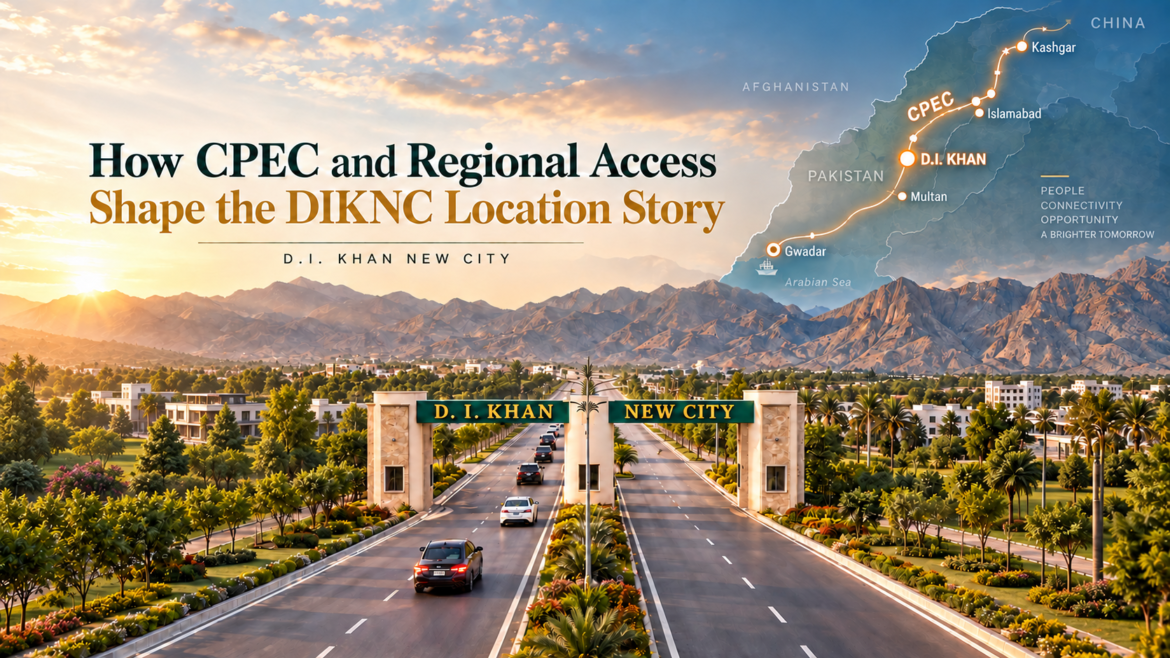
In real estate, location is rarely just about where a project sits on a map. The more useful question is how that location connects with the wider region, major transport routes, economic activity and future urban growth. For D. I. Khan New City (DIKNC), the broader connectivity story is closely linked with Dera Ismail Khan’s position along important regional road networks and the western alignment associated with the China-Pakistan Economic Corridor (CPEC).
That connection does not mean every nearby real estate project automatically benefits in the same way, despite what some property advertising occasionally suggests with admirable enthusiasm and limited restraint. The stronger case comes from understanding the actual infrastructure around D. I. Khan and what improved accessibility can mean over time.
D.I. Khan and the CPEC Western Route
Dera Ismail Khan occupies an important position within Pakistan’s western connectivity network. According to the official CPEC Secretariat, the approved western route includes the Hakla–Yarik/D. I. Khan connection and continues through areas including Zhob, Quetta and onward toward Gwadar.
One of the most significant completed infrastructure projects supporting this connectivity is the Hakla–D. I. Khan Motorway. The CPEC Secretariat lists the project as completed and states that it was inaugurated on 5 January 2022.
This motorway strengthened D. I. Khan’s road connection toward Islamabad and the M-1 network. The National Highway Authority’s project documentation describes the route as linking Yarik near Dera Ismail Khan with Hakla on the M-1 and identifies it as part of the western corridor of CPEC.
For DIKNC, this broader regional framework helps place the project within a city that is becoming more connected with major national transport corridors.
Why Regional Access Matters for Property Buyers
For homebuyers and investors, improved road access can influence a location in several practical ways. Better connectivity may reduce travel friction, expand the geographic reach of businesses and services, support movement between cities and make emerging urban areas more accessible.
This matters particularly for a planned community such as D. I. Khan New City, where the location proposition is not only about residential plots. DIKNC’s own marketing material highlights developed residential plots alongside planned amenities including commercial areas, education, healthcare, parks, security and infrastructure.
When a planned community develops within a region experiencing improved transport connectivity, buyers may naturally begin to assess the location through a wider lens: access to employment centres, commercial movement, education, healthcare and intercity travel.
The Hakla–D. I. Khan Motorway Strengthens Northern Connectivity
The Hakla–D. I. Khan Motorway is particularly relevant because it connects the D. I. Khan region toward the Islamabad-Rawalpindi side through the national motorway network.
Official CPEC information describes the motorway as a major completed transport project, while NHA documentation explains that the alignment runs between Yarik on the N-55 near Dera Ismail Khan and Hakla on the M-1.
For the broader D. I. Khan property market, such connectivity can support the city’s relationship with northern Punjab and Islamabad. It may also make travel more practical for investors, businesses and families who maintain connections across multiple cities.
For overseas Pakistanis considering property in their home region, stronger intercity access can also make project visits, family travel and long-term planning more convenient.
D. I. Khan’s South-Western Connectivity Story
The regional story does not stop with Islamabad.
The CPEC western route also includes the D. I. Khan/Yarik–Zhob corridor, creating a strategic connection between Khyber Pakhtunkhwa and Balochistan. Official CPEC project information identifies the Yarik–Zhob N-50 section as part of the western route. Current official listings describe its upgradation as an infrastructure project still progressing through development and financing stages rather than a completed motorway connection.
That distinction matters. Future infrastructure should not be presented to buyers as though it already exists. Real estate marketing works considerably better when optimism and geography are not asked to perform interpretive gymnastics.
For DIKNC’s location story, the responsible message is that D. I. Khan sits within a broader regional connectivity framework whose different components are at different stages of completion.
CPEC Is About More Than One Road
CPEC itself is described by the official Secretariat as a framework for regional connectivity, involving transport infrastructure, trade, economic interaction and broader links between Pakistan and surrounding regions.
This gives D. I. Khan’s location story a wider context.
Rather than presenting CPEC simply as a motorway passing through the region, buyers can view it as part of a long-term effort to improve connectivity between different parts of Pakistan and potentially strengthen links with surrounding markets.
For real estate, this matters because infrastructure often influences where people choose to live, establish businesses and invest over longer periods.
Connectivity and the Growth of Planned Communities
As accessibility improves, cities frequently expand beyond older urban centres. New residential and commercial zones can emerge along better-connected corridors where land is available for more structured development.
This is where communities such as DIKNC enter the conversation.
DIKNC’s current project material presents residential plots together with features such as a 180-foot main boulevard, minimum 40-foot streets, security and surveillance, parks, commercial areas, underground sewerage, education and healthcare facilities.
These internal planning elements are different from regional infrastructure, but the two can complement each other. Regional roads determine how efficiently people reach a city or area, while internal planning determines the quality and functionality of the community once they arrive.
That combination is often more meaningful than either factor on its own.
What CPEC Could Mean for Investors
Infrastructure connectivity can be relevant to property investment, but it should never be treated as a guaranteed formula for price appreciation.
Potential investors should evaluate several factors together:
- Current road access and surrounding infrastructure
- Actual development progress within DIKNC
- Plot location and category
- Commercial and residential demand
- Payment terms and documentation
- Future infrastructure that is officially approved versus merely proposed
Improved regional accessibility can strengthen the long-term attractiveness of an area, particularly if population growth, commercial activity and urban expansion follow. However, property values ultimately depend on supply, demand, development execution and market conditions.
That is why buyers should verify current DIKNC pricing, availability, possession status and payment plans directly with the official team before making a decision.
A Location Story Built Around Access
The strongest DIKNC location story is therefore not that CPEC automatically transforms every nearby property into a high-return investment.
It is that Dera Ismail Khan has become more integrated into Pakistan’s national road network, with the completed Hakla–D. I. Khan Motorway forming an important part of that connectivity and additional western-route projects forming part of the region’s longer-term transport framework.
For DIKNC, that regional setting can add another dimension to its planned-community proposition.
Families can evaluate the location from the perspective of accessibility and lifestyle. Businesses can consider connectivity and future commercial activity. Investors can assess how transport improvements, development progress and urban growth may interact over time.
Conclusion
D. I. Khan New City sits within a city whose regional connectivity has changed significantly in recent years. The completed Hakla–D. I. Khan Motorway connects the region toward the national motorway network, while the wider CPEC western-route framework reinforces D. I. Khan’s strategic position between northern Pakistan, southern Khyber Pakhtunkhwa and routes toward Balochistan.
For buyers, the real opportunity is to look beyond slogans and understand how location, accessibility, infrastructure and planned development work together.
DIKNC’s story is therefore not only about where the community is located today. It is also about how D. I. Khan fits into a broader network of regional movement and long-term urban development.
Explore D. I. Khan New City, review the development on ground and verify the latest plot availability and payment plan with the official DIKNC team before making your property decision.
