
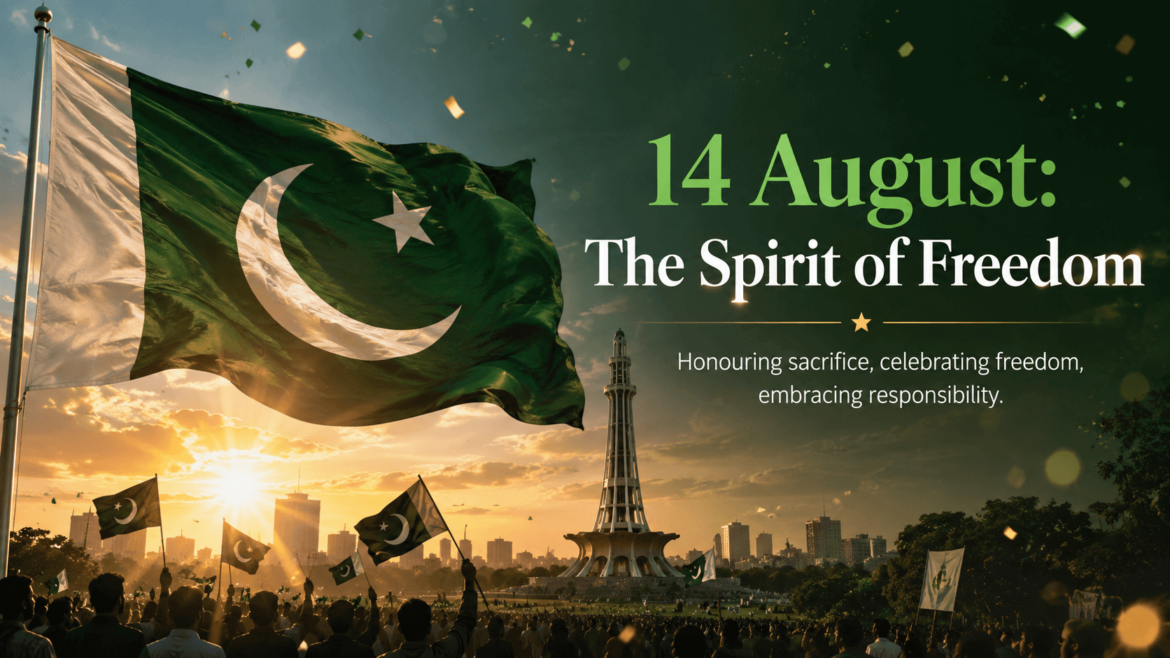
Every year, 14 August Pakistan Independence Day fills the country with green and white. Pakistani flags decorate homes, streets and buildings, while patriotic songs remind us of the journey that created our homeland.
Yet Independence Day means far more than celebrations, fireworks and flags.
Behind this historic occasion lies a story of political struggle, determination, hardship and immense sacrifice. Millions of people supported a dream that once appeared almost impossible: the creation of a homeland where Muslims of the subcontinent could live with freedom, dignity and hope.
Pakistan was not simply created on a map. It emerged through decades of struggle and the courage of people who believed future generations deserved a country of their own.
As we celebrate this important day, we should remember not only how Pakistan was created, but also what responsibility comes with the freedom we inherited.
The Beginning of the Pakistan Movement
The struggle for Pakistan began long before independence in 1947.
During British rule, Muslims of the Indian subcontinent became increasingly concerned about their political representation, cultural identity and economic future. These concerns encouraged Muslim leaders to organize politically and seek stronger constitutional protections.
The establishment of the All-India Muslim League in 1906 became an important step in this journey.
Gradually, political circumstances strengthened the belief that Muslims needed a political system in which they could preserve their identity, values and interests.
This idea eventually developed into the demand for a separate homeland.
Allama Iqbal: A Vision for the Future
Among the most influential thinkers of the Pakistan Movement was Allama Muhammad Iqbal.
Through his philosophy, poetry and political thought, Iqbal encouraged Muslims to develop confidence, knowledge and self-respect. His concept of Khudi, or selfhood, emphasized personal strength, character and the ability to shape one’s future.
More importantly, Iqbal helped inspire the political imagination of Muslims in the subcontinent.
His vision encouraged people to think beyond their immediate circumstances and consider a future in which they could determine their own political and social direction.
Although Allama Iqbal passed away in 1938 and did not witness the creation of Pakistan, his ideas remained deeply connected with the movement that followed.
Quaid-e-Azam and the Struggle for Pakistan
Turning the dream of Pakistan into political reality required extraordinary leadership.
Quaid-e-Azam Muhammad Ali Jinnah led the Pakistan Movement through years of negotiations, political disagreements and intense pressure.
His leadership relied on constitutional struggle, political organization and a clear understanding of Muslim political rights.
Rather than abandoning the cause during difficult periods, Quaid-e-Azam remained focused on achieving a political solution.
His principles of Unity, Faith and Discipline continue to represent some of the most important values associated with Pakistan.
Despite serious health challenges during the final years of the independence movement, he continued working tirelessly.
Such dedication reminds us that Pakistan was created through persistence, discipline and an extraordinary sense of national purpose.
The Lahore Resolution: A Historic Turning Point
A major milestone came on 23 March 1940, when the Lahore Resolution was adopted during the annual session of the All-India Muslim League.
This resolution strengthened the political demand for separate arrangements for Muslim-majority regions of British India.
In the years that followed, support for the Pakistan Movement expanded across the subcontinent.
Students participated in campaigns, political workers travelled to different communities, and intellectuals, professionals, journalists and ordinary families supported the cause in different ways.
Therefore, the creation of Pakistan was not the achievement of a single leader.
It became a collective movement supported by millions of people who believed in the possibility of a better future.
Finally, Pakistan emerged as an independent state on 14 August 1947.
The Sacrifices Behind Independence
Freedom brought hope, but the events surrounding Partition also brought enormous suffering.
Millions of people were forced to leave their homes and migrate across newly created borders. Families abandoned property, businesses, farmland and communities where they had lived for generations.
Many journeys were filled with fear and uncertainty.
Some families became separated, while countless people lost relatives and loved ones during the violence surrounding Partition.
For refugees travelling toward Pakistan, independence often meant starting life again with almost nothing.
They carried hope for a new homeland, even when the road toward that homeland demanded enormous personal sacrifice.
These experiences should never be reduced to a few lines in a history book. They remain an essential part of Pakistan’s national memory.
Starting a New Country From Scratch
The challenges did not end once Pakistan achieved independence.
A new state had to build administrative systems, institutions, infrastructure and public services while simultaneously accommodating a huge number of refugees.
Resources were limited, and many institutions had to be established almost immediately.
Despite these difficulties, people came together to build the country.
Civil servants worked under challenging conditions. Teachers educated new generations. Doctors treated communities. Farmers supported food production, while entrepreneurs and professionals helped develop the economy.
Pakistan survived its difficult early years because people were prepared to contribute.
That resilience remains one of the most powerful lessons of our history.
What Does Independence Mean Today?
For younger generations, the struggle for Pakistan can sometimes feel distant.
Most Pakistanis today were born into a country whose borders, flag and institutions already existed. Because we did not personally experience the independence movement, freedom can easily feel permanent and automatic.
However, independence carries responsibility.
A strong nation cannot depend only on patriotic songs, flags and celebrations once a year.
True patriotism appears in everyday actions.
It can be seen in how responsibly we perform our jobs, how honestly we conduct business, how respectfully we treat others and how seriously we fulfil our duties as citizens.
The strength of Pakistan ultimately depends on the contribution of its people.
Be Honest and Responsible Citizens
One of our greatest responsibilities is to practice honesty and integrity.
Whether someone is a student, teacher, business owner, government employee, professional or labourer, doing one’s work sincerely contributes to national progress.
Corruption, dishonesty and negligence weaken institutions and reduce public trust.
By contrast, responsible citizens strengthen society.
Patriotism should therefore begin with personal accountability.
Invest in Education and Knowledge
No modern country can progress without education, innovation and scientific advancement.
Pakistan has a large young population with enormous potential.
Providing quality education, technical training and opportunities for research can help young people compete globally and contribute to national development.
Encouraging entrepreneurship and digital skills is equally important.
An educated and skilled generation can become one of Pakistan’s greatest strengths.
Respect Diversity and Strengthen Unity
Pakistan is home to different languages, cultures, regions and traditions.
This diversity should strengthen our society rather than divide it.
People may disagree politically or socially, but disagreement should never eliminate mutual respect.
National progress requires tolerance, cooperation and dialogue.
When citizens respect one another while remaining united around their shared national identity, Pakistan becomes stronger.
Contribute to Pakistan’s Economy
Economic strength is essential for national independence and long-term stability.
Entrepreneurs who create businesses and jobs contribute directly to Pakistan’s future. Skilled professionals, responsible taxpayers, exporters and innovators also play an important role.
Increasing productivity and supporting local industries can strengthen the country’s economic foundations.
Instead of depending entirely on others to create opportunities, Pakistan needs more people willing to create opportunities themselves.
Protect Pakistan’s Environment
National responsibility also includes protecting the environment.
Pakistan faces growing environmental challenges, including pollution, water shortages and pressure on natural resources.
Citizens can contribute by conserving water, planting trees, reducing waste and keeping public spaces clean.
Governments and businesses also have an important role in encouraging sustainable development.
Protecting the environment today means protecting the quality of life of future generations.
Represent Pakistan Positively
Pakistanis living inside the country and abroad represent the nation through their actions.
Professional excellence, honesty and responsible behaviour can help create a positive image of Pakistan internationally.
Achievements in science, technology, education, business, sports and the arts also contribute to national pride.
Every Pakistani who performs exceptionally in their field adds something valuable to the country’s reputation.
Turn Complaints Into Contribution
Pointing out problems is easy. Building solutions requires more effort.
Instead of asking only what Pakistan has done for us, we should also consider what we are doing for Pakistan.
A teacher educating students sincerely contributes to the country.
An entrepreneur creating employment strengthens the economy.
A doctor treating patients with dedication serves society.
Similarly, a student working toward excellence, a citizen following the law or someone helping their community contributes to national development.
Nation-building happens through millions of such everyday actions.
Making Pakistan Proud
The generation that struggled for independence fulfilled an extraordinary responsibility.
They fought politically for a homeland, endured uncertainty and faced enormous personal sacrifices.
Their struggle gave future generations an independent Pakistan.
Our responsibility is different.
We must create a country known for education, innovation, economic strength, justice and strong institutions.
Pakistan should become a place where young people can build meaningful futures, businesses can grow, communities can prosper and talent can flourish.
That vision will not be achieved through celebration alone.
It requires consistent effort from every generation.
This 14 August, Renew the Promise
As the Pakistani flag rises proudly this 14 August, celebrations should remind us of both our freedom and our responsibility.
Remember the leaders who dedicated their lives to the Pakistan Movement.
Think about the families who left their homes during Partition.
Honour those who endured hardship because they believed Pakistan was worth the sacrifice.
Most importantly, consider what kind of Pakistan we will leave for future generations.
Our founders gave us freedom. Our responsibility is to transform that freedom into progress.
Through education, honesty, unity, hard work and responsible citizenship, every Pakistani can play a role in building a stronger nation.
This Pakistan Independence Day, let us not simply celebrate the country we inherited.
Let us commit ourselves to building the Pakistan future generations deserve.
Pakistan Zindabad. 🇵🇰
